
The technology
How the treatment works
Explained simply, without the jargon. What the machine does, what an hour in it feels like, and everything we check before you begin.
In one minute
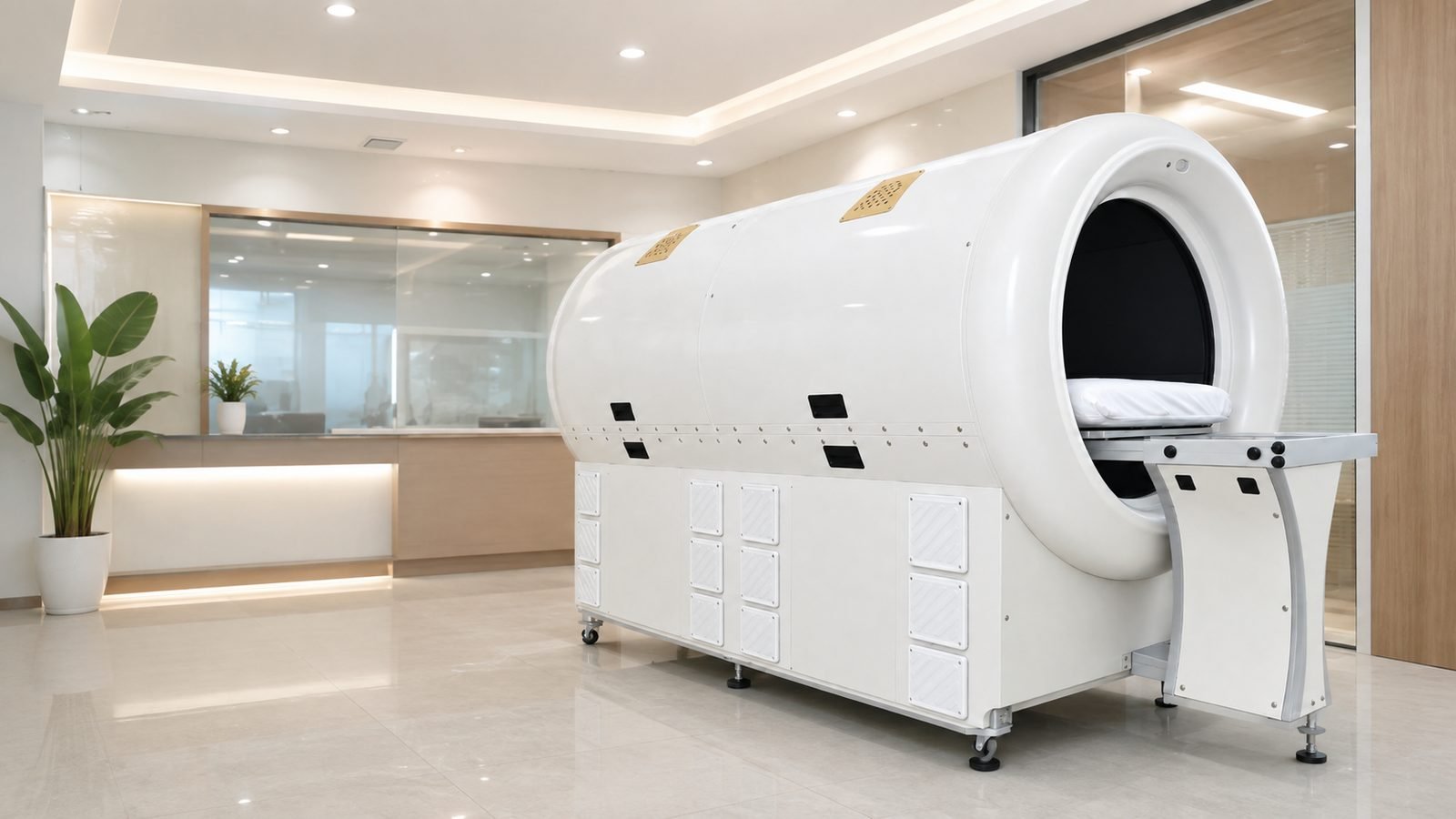
The Cytotron® is a machine you lie inside, fully clothed, for about an hour a day. It sends gentle radio-frequency and magnetic signals to an area mapped from your own scans. Nothing touches you, nothing is injected, and most people feel nothing at all. The signals sit at the safe, low-energy end of the spectrum — below the frequency of a mobile phone, and quite different from the radiation used in X-rays or radiotherapy.
The question we hear most
"Is this radiation?" No — and here's why that matters.
The Cytotron® works at the non-ionising, low-energy end of the electromagnetic spectrum, below microwave and mobile phone frequencies. Non-ionising means the energy is too gentle to disturb the electrons in atoms — which is the mechanism by which X-rays, CT scans and radiotherapy affect DNA.
In practical terms: no radioactivity at any stage, and none of the cumulative dose limits that apply to radiotherapy.
And that isn't only the manufacturer's claim. Before the device's first clinical study, its emissions were independently tested by the Electronics and Radar Development Establishment, a Ministry of Defence laboratory, and found to be well below the exposure limits set by the International Commission on Non-Ionizing Radiation Protection. For cancer treatment the delivered radio frequency stays under 100 MHz — firmly in the non-ionising, non-thermal range.

What a session feels like
An hour that asks almost nothing of you.
Settling in
You lie on a comfortable couch, fully clothed. Jewellery, watches and your phone stay outside. We check your position against your plan so the same area is treated accurately every day.
The hour itself
The machine runs its programme. Nothing touches you and there's nothing to feel. Bring headphones — people read, listen to music, or rest. A good number of our patients fall asleep.
Straight afterwards
You get up and leave. No sedation, no recovery time. You can drive yourself, eat normally and go to work. Some people notice mild tiredness over the first few days.
Across the course
Sessions run daily over a defined course; in the published clinical study this was one hour a day for 28 consecutive days. The timetable is planned into the rest of your treatment, and we agree the sequencing with you and your oncologist.
How it's designed to work
It targets a difference that's already there.
Every cell in your body carries a small electrical charge across its outer surface. Doctors call this the transmembrane potential. It takes part in how a cell signals, how it moves nutrients in and out, and how it decides when to divide.
Cells that divide rapidly, as tumour cells do, carry a different charge from healthy resting tissue. This difference is well recognised in cell biology, and the Cytotron® is designed around it — delivering computed signals to a mapped target area with the aim of influencing that charge and, through it, the protein pathways that support rapid cell division.
Research into how this works in practice is ongoing, and we'll always be straightforward with you about what's established and what's still being studied.
Want the full explanation?
Our patient’s guide covers the science in depth, with diagrams: how the signals are planned from your scans, how RFQMR differs from radiotherapy, and what the research has and has not established.
Safety and comfort
Generally very well tolerated.
The therapy is non-invasive and needs no anaesthesia. Most people notice nothing at all. When someone does, it's usually mild and settles quickly: a little tiredness in the first few sessions, perhaps some warmth or slight tingling where they're being treated, or a few nights of changed sleep.
The published 98-patient trial bears this out: across more than 2,400 treatment hours in seriously unwell patients there were no serious adverse events, the effects reported were mild and passing, and no patient stopped treatment because of a side effect. The study in detail.
Before you begin
What we check first.
A few situations mean the Cytotron® is best avoided or needs particular assessment. We go through all of these with you:
- Implanted electronic devices: pacemakers, defibrillators, cochlear implants, nerve stimulators and infusion pumps
- Certain metal implants, clips or prostheses — we assess these individually against your implant paperwork
- Pregnancy
- Blood cancers such as leukaemia, lymphoma and myeloma. The device targets a defined tumour area, so it suits solid tumours
- Being able to rest comfortably for an hour. If pain or anxiety would make that difficult, we talk through how to manage it first
Fitting into your wider treatment
We work with your oncologist, not instead of them.
Cytotron® therapy is planned into your overall treatment, not bolted on to it. Where it sits, and in what order, depends on your diagnosis, where you are in your current treatment and what your oncology team advises — so it is worked out individually rather than assumed. With your permission we write to your oncology team and plan it together, so your main treatment always comes first. Send your reports and we will explain honestly how it would fit for you.
Medically reviewed by [NAME, QUALIFICATION, REGISTRATION NO.] · Last reviewed [MONTH YEAR]
Still not sure this applies to you?
That's exactly what the free review is for. Send your reports and a doctor will tell you plainly whether Cytotron® therapy suits your situation — including when it doesn't.
See the cancers we treatSend your reports
Three short steps. A doctor reads your file properly and replies within one working day — no charge, no obligation.
- 1About you
- 2The diagnosis
- 3Your reports
Step 1 of 3 — About you
- No charge
- Reply in 1 working day
- Seen only by our clinicians
Prefer to skip the form? Message us on WhatsApp. For anything urgent, please ring your treating hospital. More ways to reach us.